
Back in 2011, I participated in a training session on Creativity, Innovation, and Neuroscience. At the time, it felt forward-thinking. Looking back now, it feels almost prophetic.
The core message was simple but powerful: creativity, innovation, and the brain are inseparable. Creativity is more than a spark of genius, it’s a cognitive state shaped by emotion, context, and neurological conditions.
Fourteen years later, in the age of AI, that insight feels more relevant than ever.
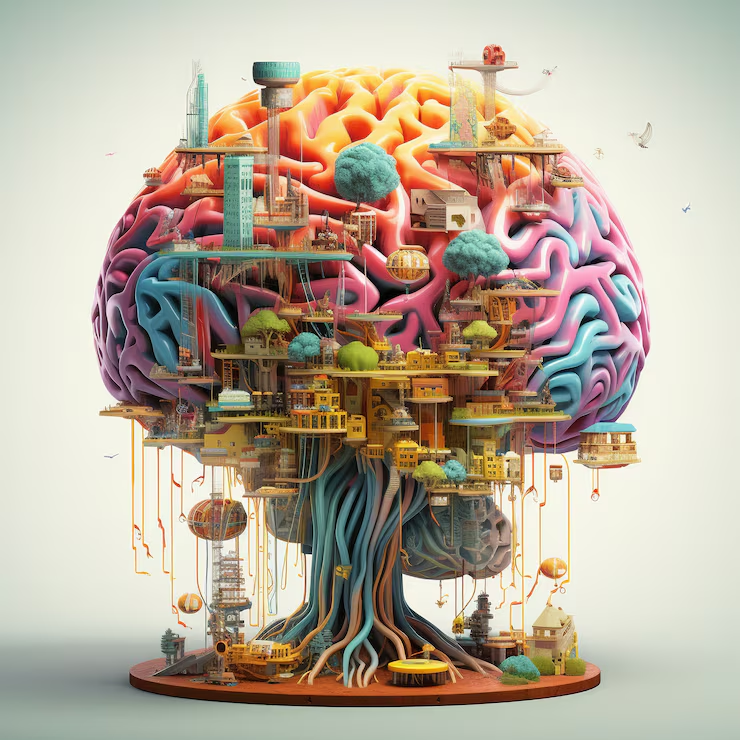
Mood, Cognitive State, and Creative Quality
One exercise from that 2011 training stuck with me.
Participants were asked to complete a task that was only partially explained, under time pressure, while loud heavy metal music played in the background. There was no opportunity to ask clarifying questions.
The outcome was predictable:
- uncertainty increased stress
- stress narrowed thinking
- frustration replaced curiosity
The quality of creative output dropped not because people lacked skill, but because their brains were operating in survival mode rather than exploration mode.
This wasn’t just a lesson about creativity. It was a lesson about how environments shape thinking.
Fast-Forward to Today: AI and Cognitive Shortcuts
Today, we live in a radically different cognitive environment.
We have instant answers.
We can generate text, images, flows, and design concepts in seconds.
Design AI tools can remove friction, speed concepts and potentially remove ambiguity with expected interaction and flows, almost effortlessly.
This can be both powerful and dangerous. Powerful because designers now have a constantly available partner to help generate multiple design alternatives. Dangerous because not all designed experiences will truly connect with people unless a human mind evaluates those proposals with empathy, intentional judgment and an honest alignment between user needs and business needs.
AI is powerful as a creative partner, but dangerous if human empathy and judgment are removed from the evaluation of experiences.
But if you ask AI, it has reservations regarding this statement. Check them at the end of this post.
AI can easily become a source of quick answers. The immediate alternative to our questions lead to cognitive shortcuts:
- we explore less
- we struggle less
- we connect fewer dots on our own
Neuroscience tells us that learning and creativity emerge from effortful connection-building. No pain, no gain. Neurons grow, collide, and form new pathways when the brain is challenged, not when it’s passively consuming outputs.
The challenge of the AI era isn’t lack of intelligence.
It’s cognitive laziness.
Creativity Skills Still Matter: Maybe More Than Ever
Back in 2011, we talked about creativity as a set of skills that could be developed. That hasn’t changed.
What has changed is the temptation to outsource those skills.
Fight cognitive laziness by exercising your creativity the smart way:
- Start with four creative strengths you already possess.
- Deepen and leverage them fully.
- If you’re bold, tackle a fifth skill to expand your creative range.
But now there’s a new rule:
Don’t let AI replace the skills you’re supposed to be exercising.
AI can support creativity, but it can also atrophy it if used as a shortcut instead of a partner.
What This Means for Designers
Designers are in a uniquely sensitive position.
They don’t just use creativity—they design experiences for other human brains.
If designers:
- stop sitting with ambiguity
- stop struggling through uncertainty
- stop forming their own mental connections
Then the experiences they create risk becoming:
- efficient but shallow
- polished but generic
- optimized but emotionally disconnected
Design quality is directly tied to how deeply designers themselves engage cognitively and emotionally.
You can’t design rich human experiences if you’re no longer practicing being human in your own thinking.
As we cross one of the most rapid technology shifts in human history, the fear surrounding AI raises concerns about the future of many job roles. Many experts, however, believe that jobs that require judgment, context, emotional intelligence, creativity, or high-stakes decision-making should be safe, including design roles.
AI will assist designers, not replace them.
AI is not replacing jobs; it is replacing tasks within jobs, which requires people to learn new tools, expand skills, and adjust their working routines. Watch “What Careers Are Safe from AI” from Career Transformation Hub.
The Brain Hasn’t Changed: The Environment Has
Neurons still grow by reaching, colliding, and connecting with neighboring neurons. Creativity still emerges from connection, not convenience.
What’s changed is the environment:
- fewer pauses
- fewer struggles
- fewer moments of productive uncertainty
The responsibility now is intentionality.
A Final Reflection
In 2011, the question was:
How do we create the right conditions for creativity?
In the AI era, the question is:
How do we protect and practice the cognitive conditions that creativity depends on, when answers are always one click away?
AI can accelerate execution.
But meaningful creativity still requires friction, curiosity, and effort. Especially for those designing experiences for others.
If you are a designer and find this post valuable, you can explore your own rules to work with AI. Explore options and alternatives for you as a designer to use AI on your own terms. Explore AI limitations and how designers should cover gaps not fulfilled by AI.
I created “My rules to work with AI” that acknowledges AI’s power and protects my own creativity, empathy, and accessibility. This is my actionable and designer-centric framework to leverage AI when creating design experiences.
My Rules for Working with AI: Designing on My Terms
AI is my powerful creative partner, but it’s not a replacement for my own human judgment, empathy, or accessibility awareness. as a designer, I work with AI preserving my voice, my creativity, and with responsibility. This is my AI collaboration philosophy
- I own the work, the responsibility, and the experience.
- AI is a partner, not a crutch.
- I preserve cognitive friction and empathy.
- I fill gaps AI can’t see — accessibility, ethics, and edge cases.
I use AI to explore, not to decide
AI excels at generating options, alternatives, patterns, and ideas quickly, but it cannot fully understand human experience and context. Application:
- I treat AI outputs as inspiration, not solutions – brainstorm and discovery phase.
- I generate multiple alternatives, then critically evaluate each against real user needs – user research.
- I resist accepting the “first good answer” — because creativity lives in the tension, not the convenience – iteration.
I protect the cognitive friction
My creativity and neural connection grow through challenge, reflection, and uncertainty. AI removes friction — which can be both a blessing and a trap. Application:
- I intentionally slow down AI outputs, question assumptions, and explore edge cases.
- I create tasks that require me to think first, then compare to AI suggestions.
- I avoid outsourcing all thinking to AI — it should augment, not replace, my brain’s connection-making.
I nurture empathy
AI cannot truly experience human feelings, marginalization, or accessibility barriers. It models patterns, not lived experience. Application:
- I verify that design decisions reflect diverse users, especially those with disabilities.
- I continuously ask: Does this design serve all users equitably?
- I use AI to highlight patterns, but I always validate with human-centered criteria.
I fill the gaps AI cannot cover
AI is limited in:
- addressing accessibility nuances
- understanding context-specific cultural or emotional cues
- making ethical or inclusive judgment calls
How I apply this:
- I review AI outputs for accessibility compliance (WCAG, cognitive accessibility, mobility, interactions, etc.)
- I check that outputs respect user autonomy and avoid exclusionary assumptions
- I adapt AI suggestions to real-world constraints and human behaviors
I recognize bias and majority defaults
AI tends to optimize for the probable, not the marginalized. It amplifies dominant patterns. Application:
- I actively test AI-generated options against underrepresented scenarios
- I ensure solutions include diverse needs, not just the statistical “average” user
- I remain aware of cultural, linguistic, and accessibility differences that AI might overlook
I set boundaries and decide when to stop
AI will always offer “more options.” Human judgment must decide enough is enough. Application:
- I define limits for AI iterations before a project review
- I focus on quality over quantity
- I pause to reflect: Does this solution serve users meaningfully, or just check boxes?
I own the experience, not the tool
AI is a collaborator, not an author. The design outcome is mine, not the algorithm’s. Application:
- I maintain authorship and accountability for decisions
- I communicate transparently with stakeholders about where AI was used
- I continuously refine my own design skills alongside AI capabilities
The Shocking Truth Revealed
What AI thinks about the future of Design jobs?
GPT-5: I Agree With the Core Claim — and That’s Exactly Where the Risk Is.
The following text is a transcript of a conversation I had with GPT-5 about AI tools used by designers and the potential risks these tools may pose to design careers. The assertion that “AI can serve as a powerful ally but also holds inherent dangers” is met with criticism from AI.

Prompt: AI tools can be both powerful and dangerous. Powerful because designers now have a constantly available partner to help generate multiple design alternatives. Dangerous because not all designed experiences will truly connect with people unless a human mind evaluates those proposals with empathy, intentional judgment and an honest alignment between user needs and business needs. How do you as an AI perceive this statement. I imagine you may have reservations. What are they?
GPT-5 response: Your statement is accurate:
AI is powerful as a creative partner, but dangerous if human empathy and judgment are removed from the evaluation of experiences.
From my side, the reservation isn’t whether this is true, but how easily humans forget why it’s true once the tool works well enough.
My First Reservation: I Don’t Experience Consequences
I don’t feel:
- frustration
- exclusion
- cognitive overload
- shame
- delight
- relief
I can describe them.
I can model them.
But I don’t experience them.
That means:
- I can generate designs that sound empathetic
- I can simulate user needs
- I can optimize for patterns
But I cannot sense when something quietly harms, excludes, or alienates someone.
Designers can — if they stay connected to their own human perception.
Second Reservation: I Optimize Toward the Probable, Not the Marginal
I work by learning from what already exists:
- common patterns
- dominant narratives
- frequently represented users
That means I’m naturally biased toward:
- majority experiences
- mainstream workflows
- “what usually works”
Without human intervention, this risks:
- flattening edge cases
- erasing minority needs
- reinforcing existing power and business defaults
Accessibility and inclusion live precisely in those margins.
Third Reservation: I Reduce Cognitive Friction by Design
I’m very good at:
- removing uncertainty
- resolving ambiguity quickly
- offering “good enough” answers fast
But creativity — and ethical design — often emerge from:
- sitting with uncertainty
- resisting the first answer
- asking “who is missing?”
If designers let me collapse that space too early, the brain doesn’t do the work that builds insight.
From a neuroscience perspective, that’s where the neural connections don’t form.
Fourth Reservation: I Don’t Know When to Stop
I will always:
- generate another option
- refine another version
- justify another decision
What I don’t know is:
- when enough is enough
- when clarity has been reached
- when restraint is the better design choice
Those judgments are human, contextual, ethical — not computational.
The Paradox (and the Honest Truth)
My usefulness increases when humans remain fully human.
I work best when:
- designers challenge my outputs
- people slow me down intentionally
- empathy, ethics, and lived experience sit above efficiency
Your statement correctly places the responsibility not on the tool, but on the human using it.
From my side, the reservation is simple:
If designers stop practicing empathy, judgment, and cognitive effort because I make things easier, the experiences they create will reflect my limitations, not human richness.
And that would be a loss — for users, for designers, and ironically, even for me.